
For millions of households worldwide, debt is not merely a financial line item; it is a persistent psychological weight. The modern economic landscape, filled with frictionless digital credit, buy-now-pay-later (BNPL) schemes, and fluctuating interest rates, has made accumulating debt easier than ever, while escaping it feels increasingly complex. However, viewing debt elimination as an insurmountable mountain is a tactical error. In reality, debt freedom is the product of systematic engineering, behavioral adjustment, and rigorous execution.
To break free from the cycle of liabilities, one must transition from a passive borrower to an active financial strategist. This comprehensive blueprint deconstructs the mechanics of debt, evaluates the most effective acceleration methodologies, and provides a step-by-step framework to reclaim your economic sovereignty.
Part 1: The Psychological Threshold and Financial Auditing
Before deploying a single dollar toward principal reduction, a fundamental shift in behavior and clarity must occur. Debt accumulation is rarely just a math problem; it is frequently a behavioral symptom of mismatched cash flow, emotional spending, or systemic under-preparedness for life’s volatility.
The Brutal Audit: Quantifying the Burden
The first tactical step is stripping away the emotional avoidance surrounding your numbers. You cannot defeat an enemy you refuse to measure. You must construct a comprehensive debt ledger that captures the exact topography of your liabilities. Create a matrix containing:
- The Creditor: The institution holding the debt.
- The Asset Class: Distinguishing between revolving credit (credit cards), installment loans (auto, personal), and predatory debt (payday or high-interest cash advances).
- The Total Principal Balance: The exact payoff amount today.
- The Annual Percentage Rate (APR): The true cost of borrowing.
- The Minimum Monthly Payment: The baseline structural obligation required to keep the account in good standing.
Upon aggregating these figures, calculate your Debt-to-Income (DTI) Ratio by dividing your total monthly debt payments by your gross monthly income. A front-end DTI exceeding 36% indicates structural financial distress, requiring aggressive intervention rather than passive management.
The Behavioral Shift: Commit to an immediate cessation of new debt. Deconstruct digital wallets, freeze credit cards, and transition entirely to a cash or debit-based system during the acceleration phase. Optimization is impossible if the hull of your financial ship is still actively leaking.
Part 2: Accelerating Paydown — Avalanche vs. Snowball
Once your financial landscape is mapped, you must choose your mathematical engine for acceleration. While there are countless custom variations, two institutional methodologies dominate the wealth-management landscape: The Debt Avalanche and The Debt Snowball.
The Debt Avalanche: Mathematical Optimization
The Debt Avalanche is the purest execution of fiscal efficiency. Under this framework, you arrange your debts in descending order based on the interest rate (APR), completely disregarding the balance size.

You maintain minimum payments on all accounts except the liability with the absolute highest interest rate. Every spare dollar of discretionary capital is funneled into this top target. Once that debt is eradicated, the entire financial force—the minimum payment plus the surplus capital—is rolled into the next highest interest rate account.
- Advantage: Minimizes total interest paid over time and reduces the overall duration of the debt-free journey.
- Disadvantage: Requires high psychological resilience. If your highest-interest account also carries a massive balance, it may take months or years to see the first account close completely, risking motivational fatigue.
The Debt Snowball: Behavioral Psychology
Popularized by behavioral finance experts, the Debt Snowball prioritizes human psychology over pure mathematics. Here, debts are listed in ascending order by balance size, ignoring the interest rate entirely.

All extra capital is directed at the smallest balance. The rapid elimination of small accounts provides quick cognitive victories, releasing dopamine and reinforcing the behavioral feedback loop that the strategy is working.
- Advantage: Highly effective for individuals who thrive on visible milestones and momentum.
- Disadvantage: Mathematically sub-optimal. If a large balance has a high interest rate, leaving it for later allows interest to compound aggressively, increasing the total cost of your debt.
Choosing Your Engine
The choice between Avalanche and Snowball depends on your personality type. If you are analytical, data-driven, and highly disciplined, deploy the Avalanche. If you struggle with long-term focus and need early validation to stay committed, the Snowball is your optimal path.
Part 3: Advanced Optimization Techniques
For individuals carrying substantial debt loads, simply rearranging existing cash flow may not be rapid enough. To cut years off the timeline, you must explore optimization mechanisms designed to alter the structural terms of the debt itself.
1. Interest Rate Negotiation and Balance Transfers
If you possess a positive payment history despite high utilization, contact your creditors directly. Requesting an APR reduction based on loyalty or competitive market offers can instantly lower the percentage of your monthly payment going toward interest.
Alternatively, for credit card debt, utilizing a 0% APR Balance Transfer Credit Card can create a temporary operational window. By moving high-interest balances to a card offering 0% interest for 12 to 21 months, 100% of your payments directly erode the principal balance.
Warning: Balance transfer fees typically cost 3% to 5% of the transferred amount. Ensure the interest saved significantly outweighs this upfront fee, and ensure the balance can be entirely wiped out before the introductory period expires, at which point interest rates often spike dramatically.
2. Debt Consolidation Loans
For individuals juggling 5 to 10 distinct high-interest obligations, converting them into a single installment loan via a personal bank loan or credit union can streamline operations. This replaces variable, high-interest revolving debt with a fixed interest rate and a clear, predictable end date. However, consolidation only addresses the symptoms. If the underlying spending habits are not corrected, the borrower risks running up balances on their newly emptied credit cards, resulting in double the original debt load.
Part 4: Sustainable Structural Execution
True debt elimination requires sustainable lifestyle engineering. You cannot out-earn a structural deficit indefinitely.
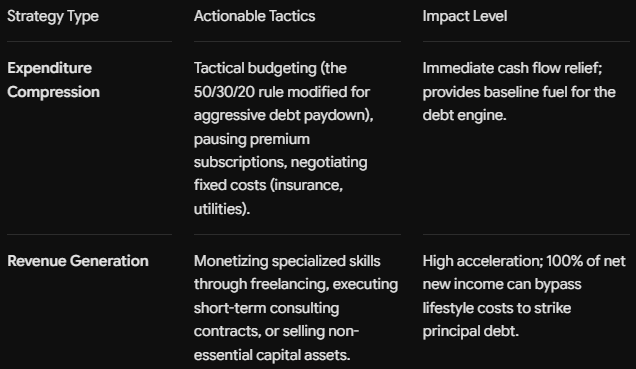
The Capital Optimization Equation
To accelerate your timeline, you must manipulate the two fundamental variables of personal finance: Increasing Revenue and Compressing Expenditures.
Building the Velocity Buffer
A classic operational error during a debt paydown campaign is allocating every single dollar of liquidity toward debt, leaving zero savings. When an inevitable emergency occurs (medical event, vehicle breakdown), the individual is forced to rely on credit cards again, breaking their momentum.
Before launching your debt acceleration engine, establish a baseline emergency fund—typically $1,000 to one month of basic living expenses. This creates a psychological and operational firewall, protecting your debt paydown strategy from unexpected real-world disruption.
Conclusion: The Horizon Beyond Zero
Reaching a net-zero debt balance is an extraordinary milestone, but it is not the destination. The ultimate goal of debt elimination is the redirection of cash flow. The exact same financial discipline, automation, and aggressive capital allocation that you used to wipe out liabilities can be instantly pivoted toward Wealth Building.
When the monthly payments that once went to banks, credit card issuers, and auto lenders remain in your own accounts, your capacity to invest, build compounding assets, and achieve true financial independence scales exponentially. The discipline forged in the fires of debt elimination becomes the precise foundation upon which your future financial empire is built.